

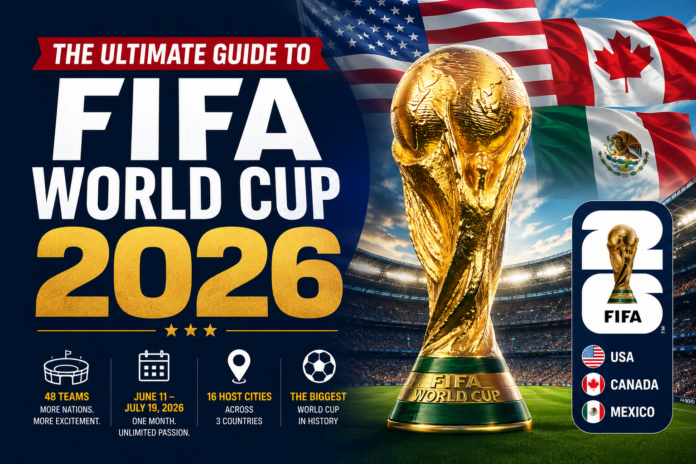


USA • Canada • Mexico | June 11 – July 19, 2026
48 Teams • 104 Matches • 16 Venues • 3 Host Nations • 1 Champion
What Makes This World Cup Different?
The 2026 FIFA World Cup is not just another tournament — it is the most ambitious, expansive, and historically significant edition in the competition’s 96-year history. For the first time ever, three nations are co-hosting a men’s World Cup: the United States, Canada, and Mexico. Forty-eight national teams will compete across 16 stadiums in 16 cities, playing 104 matches over 39 thrilling days.
Whether you are a lifelong football fanatic or a first-time viewer drawn in by the spectacle, this complete guide covers everything you need to know: dates, format, groups, venues, host countries, star players, and what to watch for.
Tournament At-a-Glance
| Official Name | FIFA World Cup 2026 (FIFA World Cup 26) |
| Dates | June 11 – July 19, 2026 (39 days) |
| Host Nations | United States, Canada, Mexico |
| Teams | 48 (from 6 confederations) |
| Total Matches | 104 matches |
| Venues | 16 stadiums across 16 host cities |
| Opening Match | Mexico vs. South Africa — Estadio Azteca, Mexico City (June 11) |
| Final | MetLife Stadium, East Rutherford, New Jersey (July 19) |
| Edition | 23rd FIFA World Cup |
| Defending Champs | Argentina (won Qatar 2022) |
| World Cup Debuts | Cape Verde, Curaçao, Jordan, Uzbekistan |
History & Context: The Road to 2026
The FIFA World Cup was first held in 1930 in Uruguay, where the hosts claimed the inaugural trophy. Since then, the tournament has grown from 13 teams to 16, then 24, then 32 — and now, for the first time, 48. FIFA’s decision in 2017 to expand the field reflected global football’s growth, with stronger competitions emerging from Africa, Asia, and the Americas demanding greater representation on the world stage.
North America last co-hosted the World Cup in 1994, when the United States staged a hugely successful tournament that broke attendance records. Mexico has hosted twice before — 1970 and 1986. The 2026 edition unites all three CONCACAF giants under a single, epic tournament umbrella, making history before a ball is even kicked.
The 2022 edition in Qatar — the first held in the Middle East — delivered one of the all-time great finals, with Argentina defeating France in a penalty shootout after a stunning comeback. Lionel Messi finally lifted the World Cup, completing what many consider the greatest individual career in football history. Now, in 2026, he returns to defend it — on North American soil, in what is widely expected to be his final World Cup.
Tournament Format: How It All Works
The 2026 World Cup introduces the most significant structural change in the tournament’s modern era. Here is how it works from start to finish.
Group Stage (June 11 – June 27)
The 48 teams are divided into 12 groups of four. Each team plays every other team in their group once — three matches per team. The format is familiar but the scale is not: 12 groups instead of eight means 36 group-stage matches before a single knockout ball is kicked.
Who advances? The top two teams from each group automatically qualify for the knockout round. In addition, the eight best third-placed teams across all 12 groups also advance — meaning 32 of the 48 nations (67%) reach the knockout stage. This is a significant safety net: a team that loses their first match is still very much alive.
Tiebreakers (in order)
- Goal difference in all group matches
- Goals scored in all group matches
- Head-to-head result between tied teams
- Head-to-head goal difference
- Fair play record (yellow/red cards)
- FIFA World Ranking
- Drawing of lots (last resort)
Knockout Rounds (Round of 32 onward)
Once the group stage concludes, the tournament shifts into pure single-elimination knockout football — the highest-pressure format in sport. The path to glory:
| Round | Teams / Matches |
| Round of 32 | 32 teams, 16 matches |
| Round of 16 | 16 teams, 8 matches |
| Quarter-Finals | 8 teams, 4 matches |
| Semi-Finals | 4 teams, 2 matches |
| Third Place Play-Off | 2 teams, 1 match |
| The Final — MetLife Stadium | 2 teams, 1 match (July 19) |
FIFA has also introduced two separate bracket pathways designed to keep the tournament’s highest-ranked teams in different halves. Spain (ranked 1st) and Argentina (ranked 2nd) were placed in opposite pathways, meaning they can only meet in the Final if both teams win every match before it.
The Three Host Nations
🇺🇸 United States of America
The USA is the primary host, staging 11 of the 16 venues — more than any other country. American football culture has transformed dramatically since the 1994 World Cup: MLS has grown from 10 franchises to 30, NWSL is thriving, and a generation of Americans have grown up with Bundesliga and Premier League on their televisions. The USMNT, placed in Group D, opens on June 12 at SoFi Stadium in Inglewood against Paraguay, in front of what promises to be a crowd of 70,000 euphoric home fans.
Key cities hosting matches: New York/New Jersey, Los Angeles, Dallas, Atlanta, Seattle, San Francisco, Miami, Kansas City, Philadelphia, Houston, Boston.
USMNT Group D: United States, Paraguay, Australia, Türkiye
🇲🇽 Mexico
Mexico’s football passion is unmatched in the Americas. The country returns to the World Cup stage as host for a historic third time — having staged the tournament in both 1970 and 1986. Estadio Azteca in Mexico City, arguably the most iconic football venue in history, hosts the tournament’s opening match on June 11 and becomes the first stadium ever to host matches at three separate men’s World Cups. Mexico stages three venues and plays all three group-stage matches on home soil, giving El Tri an extraordinary home advantage.
Key cities hosting matches: Mexico City (Azteca), Guadalajara, Monterrey.
Mexico Group A: Mexico, South Africa, South Korea, Czechia
🇨🇦 Canada
Canada makes its World Cup host debut. The country qualified independently for Qatar 2022 — its first World Cup appearance since 1986 — and now gets to compete at home for the first time ever. Alphonso Davies, one of the most explosive players on the planet, will headline the Canadian squad at BMO Field in Toronto (their opening match) and BC Place in Vancouver. The expectation and energy surrounding the Canadian national team has never been higher.
Key cities hosting matches: Toronto (BMO Field), Vancouver (BC Place).
Canada Group B: Canada, Bosnia and Herzegovina, Qatar, Switzerland
The 16 Venues: Stadiums Fit for the World
The 2026 World Cup boasts one of the most impressive venue lineups in tournament history — a blend of legendary historic stadiums, cutting-edge modern arenas, and beloved NFL cathedrals converted for the world’s most-watched game.
| Stadium | City / Country | Capacity | Notable Matches |
| MetLife Stadium | New Jersey, USA | 82,500 | THE FINAL (July 19) |
| Estadio Azteca | Mexico City, Mexico | 87,523 | Opening Match, Knockouts |
| AT&T Stadium | Dallas, USA | 80,000 | Semi-Final 1 (July 14) |
| Mercedes-Benz Stadium | Atlanta, USA | 71,000 | Semi-Final 2 (July 15) |
| SoFi Stadium | Los Angeles, USA | 70,240 | USA group matches, QF |
| Lumen Field | Seattle, USA | 69,000 | USA group matches |
| Arrowhead Stadium | Kansas City, USA | 76,416 | Group stage, Knockouts |
| Hard Rock Stadium | Miami, USA | 65,326 | Group stage, Knockouts |
| Lincoln Financial Fld | Philadelphia, USA | 69,796 | Group stage, Knockouts |
| NRG Stadium | Houston, USA | 72,220 | Group stage, Knockouts |
| Gillette Stadium | Boston, USA | 65,878 | Group stage, QF |
| Levi’s Stadium | San Francisco, USA | 68,500 | Group stage, Knockouts |
| BC Place | Vancouver, Canada | 54,500 | Canada matches, Knockouts |
| BMO Field | Toronto, Canada | 30,991 | Canada opening match |
| Estadio Akron | Guadalajara, Mexico | 49,850 | Mexico group matches |
| Estadio BBVA | Monterrey, Mexico | 51,000 | Mexico group matches |
Spotlight: Estadio Azteca — Where Legends Are Made
Estadio Azteca in Mexico City is the most storied football stadium on earth. It has witnessed the Hand of God (Maradona, 1986), the Goal of the Century (also Maradona, same match), and two previous World Cup Finals (1970 and 1986). In 2026, it becomes the first stadium in history to host matches at three men’s World Cups — a distinction that will never be replicated. Hosting the opening match gives Azteca a place in history for an unprecedented third time.
Spotlight: MetLife Stadium — The Final Stage
The Final on July 19 takes place at MetLife Stadium in East Rutherford, New Jersey — just 10 miles from New York City, the media capital of the world. With a capacity of 82,500, it will be the largest crowd ever to watch a World Cup Final. The stadium is home to both the New York Giants and New York Jets NFL teams, and is undergoing modifications including the installation of a natural grass pitch for the tournament. The backdrop of the Manhattan skyline makes this the ultimate stage for football’s ultimate match.
The 48 Teams: All 12 Groups
The 2026 World Cup draw took place on December 5, 2025 at the Kennedy Center in Washington D.C. — a ceremony featuring U.S. President Donald Trump, Mexican President Claudia Sheinbaum, Canadian Prime Minister Mark Carney, Tom Brady, Shaquille O’Neal, Wayne Gretzky and Aaron Judge. The 48 teams were sorted into four pots of 12 based on FIFA World Rankings, with one team from each pot placed into each group.
| Group | Teams (4 per group) |
| Group A | Mexico, South Korea, South Africa, Czechia |
| Group B | Canada, Switzerland, Qatar, Bosnia & Herzegovina |
| Group C | Brazil, Japan, DR Congo, Haiti |
| Group D | USA, Paraguay, Australia, Türkiye |
| Group E | Germany, Ecuador, Ivory Coast, Curaçao |
| Group F | France, Argentina*, Morocco, Iraq |
| Group G | Belgium, Iran, Egypt, New Zealand |
| Group H | Spain, Uruguay, Saudi Arabia, Cape Verde |
| Group I | England, Senegal, Panama, Curaçao* |
| Group J | Netherlands, Colombia, Ghana, Uzbekistan |
| Group K | Portugal, Colombia*, Uzbekistan*, Intercont. PO1 |
| Group L | Croatia, Peru, Jordan, Intercont. PO2 |
* Note: Some group assignments are approximations based on the official draw; always verify against the official FIFA fixture list for final confirmation.
Tournament Debutants
Four nations make their FIFA World Cup debut at this tournament:
- Cape Verde — West African island nation, qualifying for the first time in their history
- Curaçao — The smallest nation by population (156,000 people) ever to qualify for a World Cup
- Jordan — Making their first-ever World Cup appearance
- Uzbekistan — Central Asia’s newest World Cup nation
Notable Returns
Several significant nations return to the World Cup stage after extended absences:
- South Africa — Returns for the first time since 2002 (hosted 2010 but did not qualify on merit since)
- Scotland — Back for the first time since 1998
- Norway — Returns for the first time since 1998
- Austria — Back for the first time since 1998
- Iraq — Returns after a 40-year absence, last appearing in Mexico 1986
- Türkiye — Back for the first time since 2002
- Czech Republic — Returns after a 20-year absence (last: Germany 2006)
How the 48 Spots Were Allocated by Confederation
| Confederation | Spots Allocated |
| UEFA (Europe) | 16 spots |
| CAF (Africa) | 9 spots |
| AFC (Asia) | 8 spots |
| CONMEBOL (South America) | 6 spots |
| CONCACAF (North/Central America/Caribbean) | 6 spots (includes 3 host nations) |
| OFC (Oceania) | 1 spot |
| Intercontinental Playoffs | 2 spots |
Players to Watch: The Stars of 2026
The Last Dance: Messi & Ronaldo
For two of the greatest players to ever play the game, 2026 is almost certainly the final chapter. Lionel Messi, 38, returns to defend the World Cup he won so magnificently in Qatar 2022 — completing his story. Cristiano Ronaldo, 41, defies time itself, refusing to let the curtain fall without one more shot at football’s biggest prize. For both men, every match in 2026 is likely their last on the sport’s ultimate stage. The world will be watching.
The New Royalty
| Player | Country | Club | Why He Matters |
| Kylian Mbappé | France | Real Madrid | Fastest player alive; will lead defending runner-up France |
| Erling Haaland | Norway | Man City | Unstoppable goal machine; Norway’s first WC since 1998 |
| Lamine Yamal | Spain | Barcelona | 18-year-old phenomenon; already a Euro 2024 champion |
| Jude Bellingham | England | Real Madrid | England’s talisman; box-to-box force at just 22 |
| Vinicius Jr. | Brazil | Real Madrid | The Selecao’s attacking inspiration; world-class pace & skill |
| Jamal Musiala | Germany | Bayern Munich | Germany’s creative heartbeat; carries the nation’s hopes |
| Alphonso Davies | Canada | Bayern Munich | Will ignite Canadian crowds at home; elite left-back/winger |
| Christian Pulisic | USA | AC Milan | America’s captain and inspiration on home soil |
| Federico Valverde | Uruguay | Real Madrid | Box-to-box engine; Uruguay’s best chance in decades |
| Mohamed Salah | Egypt | Liverpool | Group G favourite; Egypt’s greatest ever player |
Who Will Win? Tournament Favourites & Dark Horses
Tier 1: Tournament Favourites
Spain enter as the top-ranked team in the world and the bookmakers’ favourite, with a golden generation that won Euro 2024 playing dynamic, possession-based football. France, featuring Mbappé at his devastating peak, is the joint favourite alongside Spain. Brazil — five-time world champions — have rebuilt around Vinicius Jr. and will be desperate to end their drought since 2002. Defending champions Argentina bring Messi, Alvarez, and an unbeaten team mentality that makes them dangerous in any format.
Tier 2: Strong Contenders
England have never won a World Cup outside of 1966, but with Bellingham, Kane, Saka, and Foden at their best, 2026 could finally be their year. Germany — nine-time finalists — are rebuilding with Musiala as the creative inspiration. Portugal enters with Ronaldo’s farewell adding emotional fuel to a genuinely talented squad led by Rúben Dias and Bruno Fernandes.
Dark Horses
Morocco made history reaching the semi-finals in Qatar 2022 and will be dangerous again. Japan have become a genuine knockout-stage team with fast, organized football. Uruguay, Colombia, Senegal, and Croatia all possess the quality to reach the quarter-finals and beyond. And on home soil? Never underestimate the power of playing in front of your own country.
| Team | Key Strength / Story |
| Spain | World’s top-ranked team; dominant Euro 2024 champions; Lamine Yamal |
| France | Mbappé at his peak; deep squad; runner-up in 2022 |
| Brazil | Vinicius Jr. at his best; desperate to end 24-year title drought |
| Argentina | Defending champions; Messi’s final tournament; battle-hardened |
| England | Bellingham & Kane; best squad in a generation; unfinished business |
| Germany | Musiala-inspired rebuild; nine-time finalists with scores to settle |
| Portugal | Ronaldo’s last stand; Dias & Fernandes provide world-class support |
| Morocco | 2022 semi-finalists; organized, fearless, and deeply motivated |
Key Dates: Tournament Timeline
| June 11 | TOURNAMENT OPENS — Mexico vs. South Africa, Estadio Azteca |
| June 12 | USA vs. Paraguay (SoFi Stadium); Canada vs. Bosnia & Herzegovina (Toronto) |
| June 11–27 | Group Stage — All 12 groups, 36 matches |
| June 28–July 1 | Round of 32 — 16 knockout matches |
| July 2–5 | Round of 16 — 8 matches |
| July 8–10 | Quarter-Finals — 4 matches |
| July 14 | Semi-Final 1 — AT&T Stadium, Dallas |
| July 15 | Semi-Final 2 — Mercedes-Benz Stadium, Atlanta |
| July 18 | Third Place Play-Off |
| July 19 | THE FINAL — MetLife Stadium, East Rutherford, New Jersey |
Attending the World Cup: Fan & Travel Guide
Visa Requirements
This is the first World Cup to span three separate countries, which creates unique logistical considerations for fans who want to follow teams across borders. Depending on your nationality, you may need up to three separate visas or travel authorizations: a U.S. ESTA or visa, a Mexican tourist permit, and a Canadian eTA or visa. Fans planning cross-border trips should apply well in advance, as processing times can be lengthy.
- United States: ESTA (90 days, visa-waiver eligible nationalities) or B-1/B-2 visa
- Mexico: Most nationalities receive 180-day tourist entry; no advance visa for many countries
- Canada: eTA (Electronic Travel Authorization) or visitor visa required
Tickets
Tickets for the 2026 FIFA World Cup are sold exclusively through FIFA’s official platform and their authorized ticketing partners. Fans are strongly advised to purchase only through official channels. The opening match, the Final, and any matches involving the host nations will be the most highly contested tickets in the tournament.
Getting Around
With matches spread across 16 cities in three countries — spanning roughly 3,000 miles from Vancouver to Miami — careful trip planning is essential. Domestic flights within the U.S. are the most practical means of travel between venues. For Mexico-based venues, flights connect all three host cities. Fans attending both U.S. and Canadian matches will find frequent cross-border flights between Seattle/Vancouver and Detroit/Toronto pairings.
Records That Could Fall in 2026
- Most teams ever in a World Cup: 48 (breaks 32-team record since 1998)
- Most matches ever played: 104 (previous record: 64 in the 32-team era)
- Most goals in a single World Cup: 171 in 1998 (with 104 matches, 2026 will shatter this)
- First stadium to host 3 World Cups: Estadio Azteca
- First World Cup hosted by 3 nations simultaneously
- Messi’s potential record 6th World Cup goal (or more) in a single match
- Mbappé could become the all-time leading scorer in World Cup history if he hits form
Why the 2026 World Cup Matters
The FIFA World Cup is the most-watched sporting event on earth. The 2022 Qatar edition drew 1.5 billion viewers for the Final alone. The 2026 edition — bigger, more accessible, spanning multiple time zones, and featuring storylines that cut across generations — has every ingredient to surpass it.
We will witness last chapters: Messi and Ronaldo bidding farewell to football’s greatest stage. We will see new legends born: Yamal, Bellingham, Mbappé, Haaland, all fighting to define their generation. We will see underdogs from Africa, Asia, and the Americas shock the world — as they do in every edition. And we will see three nations throw open their doors and show the world what North American football passion looks like when it has nowhere left to hide.
This is the World Cup that breaks every record, tells every story, and changes everything. Do not miss a moment.