

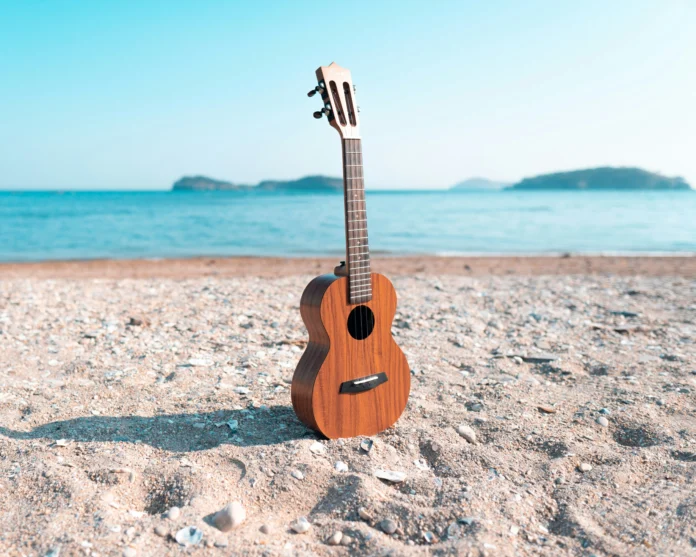


Few instruments carry as much joy per square inch as the ukulele. Small enough to fit in an overhead bin, simple enough for a child to learn, yet expressive enough to move an audience — the ukulele has traveled a remarkable path from a Portuguese ship to the stages of Carnegie Hall and the living rooms of millions. Here is its story.
Origins: Portugal to Paradise
The ukulele’s story begins not in Hawaii, as many assume, but in Portugal. In the 19th century, the island of Madeira was home to a small guitar-like instrument called the braguinha (also known as the machete). It had four strings, a compact body, and a bright, cheerful tone.
On August 23, 1879, a ship called the Ravenscrag arrived in Honolulu carrying Portuguese immigrants from Madeira, many of whom were coming to work on Hawaiian sugar plantations. Among the passengers were musicians who brought their braguinhas with them. According to historical accounts, one passenger — a cabinet maker and musician named João Fernandes — began playing the instrument on the dock as the ship arrived, delighting the crowd gathered to welcome the newcomers.
Hawaiians were captivated.
How It Became Hawaiian
Over the following years, Hawaiian craftsmen — particularly three immigrants named Manuel Nunes, José do Espírito Santo, and Augusto Dias — began building and adapting the instrument using local Hawaiian woods like koa. The result was something slightly different from the original braguinha: lighter, louder, and uniquely suited to Hawaiian music.
King Kalākaua, who reigned from 1874 to 1891, was an enthusiastic supporter of the ukulele and incorporated it into royal court performances. His patronage gave the instrument cultural legitimacy and helped embed it into Hawaiian musical identity. By the time Hawaii was annexed by the United States in 1898, the ukulele was firmly established as a symbol of the islands.
The Name
The word “ukulele” is Hawaiian, roughly translating to “jumping flea” — a vivid description of the way a player’s fingers move quickly across the strings. Another tradition holds that the name was a nickname for Edward Purvis, a small and lively British officer who played the instrument enthusiastically at the royal court. Both stories persist, and neither has been definitively disproved.
The First American Boom: 1910s–1930s
The ukulele reached the mainland United States through the 1915 Panama-Pacific International Exposition in San Francisco, where Hawaiian musicians performed and introduced the instrument to a national audience. The response was immediate and enthusiastic.
Through the 1920s, the ukulele became one of the most popular instruments in America. It was affordable, portable, and easy to learn — a perfect fit for the jazz age’s spirit of fun and accessibility. Tin Pan Alley composers wrote songs for it, department stores stocked them, and self-instruction books sold in the millions.
Performers like Roy Smeck — dubbed “The Wizard of the Strings” — elevated ukulele playing to a virtuosic art form, performing in vaudeville and early sound films.
Mid-Century Decline and the Television Revival
The ukulele’s popularity faded through the 1940s and 1950s as the guitar took center stage in popular music. However, it never disappeared entirely.
In the 1950s, entertainer Arthur Godfrey played the ukulele on his enormously popular television programs, introducing the instrument to a new generation of Americans. His influence sparked a brief commercial revival, with ukulele sales climbing again through the decade.
The Second Boom: 1990s to Today
The modern ukulele renaissance began quietly in the 1990s and exploded in the 2000s, driven by several forces:
Israel Kamakawiwoʻole, the beloved Hawaiian musician known as “IZ,” released his medley of Somewhere Over the Rainbow and What a Wonderful World in 1993. The recording — just his ukulele and his voice — became one of the most recognized pieces of music in the world, reintroducing the instrument to a global audience with extraordinary emotional power.
YouTube played a transformative role. When Canadian musician Jake Shimabukuro posted a fingerpicking cover of the Beatles’ While My Guitar Gently Weeps in 2006, it went viral and stunned millions of viewers who had no idea the ukulele was capable of such expression.
The pandemic of 2020 drove another surge in ukulele sales worldwide, as people stuck at home looked for approachable instruments to learn. Its low cost, small size, and gentle learning curve made it the instrument of choice for millions of new players.
Types of Ukulele
What began as a single instrument has expanded into a family:
- Soprano — the classic, smallest size; bright and traditional
- Concert — slightly larger, fuller tone, easier to play for larger hands
- Tenor — deeper sound, popular with performers
- Baritone — the largest, tuned differently, closest to a guitar in sound
- Bass ukulele — a modern invention with a deep, rubbery tone
The Ukulele Today
Today the ukulele is one of the best-selling instruments in the world. It is taught in schools across the United States, Japan, the United Kingdom, and beyond. It has found a home in genres ranging from classical to metal, folk to pop.
What makes it endure is perhaps what made it captivating on that Honolulu dock in 1879 — it sounds like happiness. In the hands of a beginner or a virtuoso, it carries something irreducibly cheerful.