

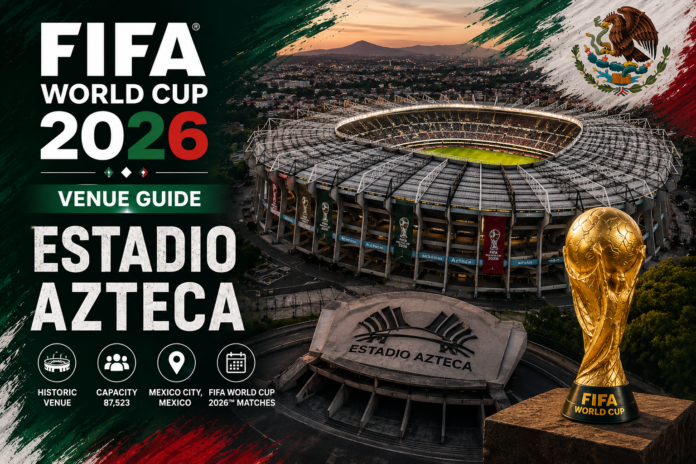


Mexico City Stadium
The Greatest Football Stadium on Earth
1970 • 1986 • 2026 — The Only Stadium to Host Three World Cups
Mexico City, Mexico | 87,523 Capacity | 2,240m Above Sea Level | Opened 1966
The Cathedral of World Football
There are famous football stadiums. There are historic football stadiums. And then there is Estadio Azteca — a venue that exists in a category entirely its own. The great cathedral of the world game. The stage where football’s most mythologised moments were born. The ground that has hosted more World Cup football than any other venue on earth, and on June 11, 2026, will extend that record by becoming the first stadium in history to host matches at three separate FIFA World Cups.
Since opening its gates on May 29, 1966, the Azteca has witnessed Pele lifting his third World Cup trophy. It hosted the Hand of God and the Goal of the Century — both scored by Diego Maradona against England, within four minutes of each other, on June 22, 1986. It has stood through earthquakes, political upheaval, and the rise and fall of countless footballing empires. It has welcomed the Pope, the Rolling Stones, the NFL, and the biggest boxing events in the history of Mexico.
And now, in 2026, it opens the largest World Cup ever staged. Sixty years after its inaugural match. Forty years after it last hosted a World Cup opening game. With a renovated capacity of 87,523 and a $150 million refurbishment that has modernised every corner of the stadium while preserving its irreplaceable soul, the Azteca is ready to write its third World Cup chapter.
This is the complete guide to Estadio Azteca — its history, its legends, its 2026 World Cup schedule, and everything you need to know to experience the greatest football stadium on earth.
Stadium Facts: At a Glance
| Official Name (2026) | Mexico City Stadium (FIFA commercial ban on corporate names during the tournament) |
| Real Name | Estadio Banorte (renamed from Estadio Azteca when Banorte Bank acquired naming rights in March 2025) |
| Colloquial Name | Estadio Azteca / The Azteca — the name by which it will always be known worldwide |
| Location | Calzada de Tlalpan 3465, Santa Ursula Coapa, Coyoacan, Mexico City, CDMX, Mexico |
| Opened | May 29, 1966 (inaugural match: Club America 2-2 Torino) |
| WC Capacity (2026) | 87,523 (restored and expanded in 2026 renovation) |
| Altitude | 2,240 metres (7,349 feet) above sea level — highest of any 2026 WC venue |
| Playing Surface | GrassMaster hybrid turf (natural grass reinforced with synthetic fibres — installed 2026) |
| Architecture | Designed by Pedro Ramirez Vazquez and Rafael Mijares Alcerrecea; opened 1966 |
| Renovation 2026 | $150 million USD; seating restored/expanded, roof repaired, hybrid pitch installed, facilities modernised; reopened March 28, 2026 |
| Tenants | Club America (Liga MX) | Cruz Azul (Liga MX) | Mexico National Team (Tri) |
| Record Attendance | 132,247 — Julio Cesar Chavez vs. Greg Haugen boxing match, February 20, 1993 |
| World Cups Hosted | 1970, 1986, 2026 — the only stadium in history to host three World Cups |
| World Cup Finals Held | 2 — 1970 (Brazil 4-1 Italy) and 1986 (Argentina 3-2 West Germany) |
The Complete History of Estadio Azteca
1960–1966: Construction and Opening
The story of Estadio Azteca begins with a vision of unprecedented ambition. In the early 1960s, Mexico City — then a metropolis of 5 million people and one of the fastest-growing cities in the world — had no stadium capable of hosting major international events. The Mexican Football Federation, backed by the government of President Adolfo Lopez Mateos, commissioned architects Pedro Ramirez Vazquez and Rafael Mijares Alcerrecea to design a world-class stadium. The brief was simple: build the largest and finest football stadium in the Americas.
Construction began in 1961 and took five years. The design was revolutionary for its time — a circular bowl with a continuous cantilevered roof that covered all four sides of the stadium, protecting spectators from the notorious afternoon rains that roll across Mexico City from the mountains. The original capacity exceeded 100,000. The stadium was built in the Coyoacan district of southern Mexico City, a neighbourhood that would later also become famous as the home of Frida Kahlo.
The Azteca opened on May 29, 1966, with a match between Club America and Italian side Torino that ended 2-2. It seated 112,000 spectators for that first match. Within the year, FIFA awarded Mexico the hosting rights for the 1970 World Cup — the Azteca’s stage on the global scale was set.
1970: The First World Cup — Brazil’s Greatest Team
The 1970 FIFA World Cup in Mexico is widely considered the finest edition of the tournament ever staged — not least because it produced what many football historians regard as the greatest team to ever play the game. Brazil, led by Pele in his third and final World Cup, swept through the tournament playing football of such extraordinary beauty and technical brilliance that it redefined what the sport could look like at its peak.
Estadio Azteca hosted the pinnacle of that tournament: the Final on June 21, 1970, between Brazil and Italy. A crowd of 107,000 packed into the stadium. Brazil won 4-1 — Pele, Gerson, Jairzinho (who scored in every match of the tournament), and Carlos Alberto all on the scoresheet. Carlos Alberto’s fourth goal — a thunderous right-foot finish after a flowing team move involving almost every player — is itself cited among the greatest goals in World Cup history. The Azteca had hosted its first World Cup Final, and it had been a masterpiece.
| 1970 World Cup FinalBrazil 4-1 Italy | June 21, 1970 | Estadio Azteca, Mexico City | Attendance: 107,412Scorers: Pele (18′), Gerson (66′), Jairzinho (71′), Carlos Alberto (86′) | Boninsegna (37′)Brazil lifted the Jules Rimet Trophy for a record third time — and kept it permanently. |
1986: The Second World Cup — Maradona’s Stage
The 1986 World Cup was never supposed to be in Mexico. Colombia were awarded the tournament in 1974 but withdrew in 1982 citing financial difficulties and political instability. Mexico stepped in as emergency hosts, just as they had done in 1970 when they replaced Argentina. The Mexican Football Federation organised the tournament in record time, and the result was one of the most dramatic, atmospheric, and historically significant editions of the World Cup ever staged.
At the centre of it all was Diego Maradona, 25 years old and at the absolute peak of his extraordinary powers. The Argentine captain produced a performance across the tournament that has never been matched — not in terms of technical brilliance, competitive dominance, and sheer force of individual will. He scored 5 goals and made 5 assists, was involved in every significant Argentine attacking move, and won the tournament’s Golden Ball award by an overwhelming margin. But it was in the quarter-final against England — at the Azteca, on June 22, 1986 — that the defining moments of his career, and of the stadium’s legend, were created.
| “A little with the head of Maradona, and a little with the hand of God.”— Diego Maradona, on his first goal against England, 1986 |
The Hand of God — 51st Minute, June 22, 1986
Six minutes into the second half of the quarter-final, England midfielder Steve Hodge attempted to clear a ball back to his goalkeeper, Peter Shilton. The clearance looped high above the penalty area. Maradona — at 5 feet 5 inches, smaller than Shilton — leapt alongside the goalkeeper and, with his left fist, punched the ball into the net. The referee, Ali Bennaceur of Tunisia, did not see the handball. The goal stood. Argentina led 1-0.
In the post-match interview, when asked how he scored, Maradona gave the response that would be quoted for the rest of his life and beyond: it was scored ‘a little with the head of Maradona, and a little with the hand of God.’ Later, he admitted it was deliberate and described it as symbolic revenge for the Falklands War — the conflict fought between Argentina and Great Britain just four years earlier, in which over 900 lives were lost. The political context made the goal, and Maradona’s brazenness, all the more electric. The shirt he wore in that match sold at Sotheby’s in May 2022 for USD $9.2 million — a world record for sports memorabilia.
The Goal of the Century — 55th Minute, June 22, 1986
Four minutes after the Hand of God, Maradona received the ball inside his own half. What followed over the next ten seconds — 60 metres, five England outfield players beaten, the goalkeeper rounded, a composed finish into an empty net — was voted the greatest goal in World Cup history in a global FIFA poll in 2002. It has never been seriously challenged for that title since.
He beat Peter Beardsley. Then Peter Reid. Then Terry Fenwick (who was booked for a desperate foul attempt that Maradona simply danced past). Then Terry Butcher, who tracked back 40 metres and still could not stop him. Then Peter Shilton, coming off his line to narrow the angle, who was dribbled around as if standing still. Then Butcher again, sliding in from behind — a fraction too late. The ball rolled into the empty net. Maradona turned, arms spread, and the 115,000 inside the Azteca — most of whom were Mexican, neutral, and already on their feet — erupted as one.
| 1986 Quarter-Final — The Match That Made HistoryArgentina 2-1 England | June 22, 1986 | Estadio Azteca, Mexico City | Attendance: 114,580Goals: Maradona (51′ — Hand of God), Maradona (55′ — Goal of the Century), Lineker (81′)Argentina won 2-1 and went on to lift the World Cup, defeating West Germany 3-2 in the Final.Maradona’s shirt from this match sold for USD $9.2 million in 2022 — the most valuable sports item ever sold. |
The 1986 World Cup Final — Argentina 3-2 West Germany
The 1986 Final, played at the Azteca on June 29 in front of 114,600 spectators, was the greatest World Cup Final since 1970 — and arguably the most dramatic of all time. Argentina led 2-0 through goals from Jose Luis Brown and Jorge Valdano, only to see West Germany — through Karl-Heinz Rummenigge and Rudi Voller — level at 2-2 in a stunning 12-minute comeback. With the match balanced on a knife-edge, Maradona delivered a precise through-ball to Jorge Burruchaga, who ran clear of the German defence and finished with eight minutes remaining. Argentina won 3-2. Maradona lifted the trophy. The Azteca had staged its second World Cup Final, and its second masterpiece.
| 1986 World Cup FinalArgentina 3-2 West Germany | June 29, 1986 | Estadio Azteca, Mexico City | Attendance: 114,600Scorers: Brown (23′), Valdano (56′), Burruchaga (84′) | Rummenigge (74′), Voller (80′)Most dramatic comeback-and-response Final in World Cup history. Maradona’s World Cup. |
1966–2026: Six Decades of Legend
Between and beyond the World Cups, the Azteca has been the venue for moments that transcend football. It hosted matches at the 1968 Mexico City Olympic Games — the first Olympics to be held in Latin America. In February 1993, 132,247 people packed inside for the WBC Super Lightweight title fight between Julio Cesar Chavez and Greg Haugen — the largest attendance ever recorded in a boxing arena, and still the Azteca’s all-time crowd record.
The Rolling Stones played here. U2 played here. Juan Gabriel — Mexico’s most beloved pop star — filled the stadium multiple times. The NFL has staged regular season games at the Azteca every year since 2016, making it the first NFL games played outside the United States and Canada in the regular season era. In November 2019, the Kansas City Chiefs defeated the Los Angeles Chargers 24-17 in front of 76,833 spectators.
And through all of it — the concerts, the boxing, the American football — the Azteca has remained, at its core, a football stadium. Home of Club America, one of the most successful and supported clubs in Mexican football history. Home of the Mexico national team, for whom the Azteca is not just a stadium but a fortress, a sanctuary, and a birthright. El Tri’s record at the Azteca stretches back 60 years — more victories, more celebrated goals, more collective national emotion than any other venue in the Americas.
The 2026 Renovation: Built for the Next 50 Years
In May 2025, Estadio Azteca closed its gates for the most comprehensive renovation in its 60-year history. The project — which cost approximately $150 million USD and was overseen by Mexico City Mayor Clara Brugada in partnership with FIFA and the local organising committee — was designed to prepare the stadium for the 2026 World Cup while ensuring it remains a world-class venue for the following five decades.
The renovation was completed on schedule, and the stadium reopened on March 28, 2026 — exactly 75 days before the World Cup’s opening match. At the reopening ceremony, Mayor Brugada declared: “We are respecting its legacy, but we also want to improve the fan experience.” Stadium director Felix Aguirre was equally unambiguous: “The stadium is moving ahead with its renovations so it can work for the next 40 or 50 years.”
What Was Renovated
- Seating: The existing seating was replaced in its entirety and the capacity restored and expanded to 87,523 — above the pre-renovation figure of approximately 83,000. New seats offer improved comfort, wider legroom, and better sightlines across all levels.
- Roof: The iconic cantilevered concrete roof — which covers all four sides of the stadium — was structurally repaired and reinforced. Several sections had deteriorated over six decades of exposure to Mexico City’s weather and the stresses caused by the 1985 and 2017 earthquakes. The roof’s silhouette — recognisable worldwide — has been preserved exactly.
- Playing Surface: A new GrassMaster hybrid pitch was installed — the same technology used by the Camp Nou, Wembley Stadium, and the Allianz Arena. GrassMaster weaves synthetic fibres into a natural grass base, dramatically improving the surface’s durability, stability, and quality under heavy use. Players and coaches who have worked on GrassMaster pitches consistently report it plays like a premium natural grass surface.
- Fan Facilities: Concourse areas were widened, food and beverage points expanded, and toilet facilities significantly upgraded across all levels. Accessibility improvements for fans with disabilities were implemented throughout the stadium.
- Media Infrastructure: The press box, television broadcast positions, and mixed-zone areas were rebuilt to FIFA’s 2026 technical specifications. High-definition broadcast cameras are positioned at multiple angles around the stadium for the global TV audience.
- Technology: New high-resolution LED scoreboards and video screens were installed in each corner of the stadium. Connectivity infrastructure (stadium-wide WiFi) was installed for the first time. A new digital ticketing and access management system was implemented.
- Commercial Areas: Corporate hospitality suites, premium club areas, and the stadium’s museum were refurbished and expanded.
| The Naming QuestionIn March 2025, Banorte Bank acquired the naming rights to the stadium — officially renaming it Estadio Banorte. However, FIFA’s commercial policies prohibit corporate stadium names during the World Cup, so the venue is officially called Mexico City Stadium in all 2026 tournament materials. Worldwide, journalists, broadcasters, and fans will continue to call it the Azteca — the name by which it has been known for six decades and will be known forever. |
The Altitude Advantage: Why the Azteca Is a Fortress
Estadio Azteca sits at 2,240 metres (7,349 feet) above sea level. This makes it the highest stadium in the 2026 FIFA World Cup by a considerable margin — no other venue comes close to this altitude. For foreign teams playing at the Azteca, the thin air of Mexico City’s high plateau presents a genuine physiological challenge that no amount of preparation can fully neutralise.
At 2,240 metres, the partial pressure of oxygen in the air is approximately 23% lower than at sea level. This means that during high-intensity efforts — sprinting, pressing, making repeated runs — players’ bodies absorb oxygen less efficiently. The result is earlier onset of fatigue, slower recovery between bursts of effort, and a measurable decline in aerobic performance for players who have not acclimatised. Teams that have not spent at least 10-14 days at altitude before their first match at the Azteca will experience these effects acutely.
Mexico, by contrast, has a significant proportion of their squad playing domestic football in Liga MX — much of which is played at comparable or even higher altitudes across Mexico City, Puebla, and Toluca. The Mexican national team has trained at the Azteca for 60 years. Their bodies know this air.
| Factor | At Sea Level | At Azteca (2,240m) |
| Oxygen availability | 100% baseline | ~77% of sea-level oxygen |
| Sprint top speed | 100% baseline | ~2-3% faster (less air resistance) |
| Aerobic endurance | 100% baseline | ~10-15% reduced without acclimatisation |
| Ball flight | Normal arc/speed | Ball travels faster, swings more unpredictably |
| Recovery between sprints | Normal | Significantly slower — fatigue accumulates faster |
| Mexico’s advantage | None | Substantial — 60 years of playing here |
| Ball Physics at AltitudeAt 2,240 metres, the air is thinner — meaning there is less air resistance on a moving football. The practical effect: shots travel faster, swerve more dramatically, and are harder to judge. Free kicks and long-range efforts that curve predictably at sea level can deviate unpredictably at the Azteca. Goalkeepers from foreign teams routinely identify altitude as one of the most disorienting aspects of playing in Mexico City. For the 2026 World Cup opening match, South Africa’s goalkeeper faces exactly this challenge. |
2026 World Cup Match Schedule at the Azteca
Estadio Azteca (Mexico City Stadium) hosts five matches at the 2026 World Cup — including the most eagerly anticipated match of the entire group stage: the tournament’s opening game on June 11, with Mexico as the host.
| Date & Time (Mexico City, CST) | Match |
| June 11 — 5:00 PM | OPENING MATCH: Mexico vs. South Africa (Group A) — The tournament begins. El Tri on home soil in the Azteca. Historic third World Cup opening game at this stadium. |
| June 15 — 3:00 PM | Group A: South Africa vs. South Korea |
| June 22 — 3:00 PM | Group A: Mexico vs. Czechia (El Tri’s final group match — could be a decider) |
| June 22 — 3:00 PM | Group A: South Korea vs. South Africa (simultaneous with Mexico vs. Czechia) |
| July 5 — 6:00 PM | Round of 32: Group winner vs. Group winner (TBD) — First knockout match at the Azteca |
| The Opening CeremonyThe 2026 World Cup features three opening ceremonies — one in each host country. Mexico’s ceremony takes place on the pitch of Estadio Azteca before the opening match on June 11. FIFA has confirmed major musical performances and cultural celebrations at all three ceremonies. The Azteca ceremony, before Mexico vs. South Africa, is expected to be the most spectacular of the three — befitting the world’s most iconic football venue hosting the world’s most important match on that day. |
Opening Match: Mexico vs. South Africa (June 11)
The choice of the Azteca to host the opening match of the 2026 World Cup was not accidental. FIFA and the local organising committee understood that no other venue in the tournament could match the symbolic weight of what June 11 represents: a tournament opening in a stadium that has defined world football for six decades, in front of 87,000 Mexican fans whose passion for the game is among the most intense on earth.
Mexico face South Africa — a nation returning to the World Cup for the first time since 2002. The matchup is symbolically rich: South Africa hosted the 2010 World Cup, the first held on African soil, opening with a 1-1 draw against Mexico in Johannesburg. Sixteen years later, the same two nations open a World Cup again — this time with roles reversed, on Mexican soil, in the Azteca. The World Cup script writes itself.
For El Tri, the opening match in their home World Cup is everything. The Azteca crowd will generate a noise unlike anything produced at any other venue in the tournament. Players from South Africa, many of whom will never have played in front of 87,000 fans at altitude before, will face a wall of sound and an atmospheric pressure that the Azteca’s design — steep, enclosed, resonant — concentrates and amplifies to overwhelming effect.
The Azteca’s Greatest World Cup Moments: Complete Record
| Year | Match | Result | Why It Matters |
| 1970 | 1970 WC Final: Brazil vs. Italy | 4-1 (Brazil) | Pele’s third World Cup title; Carlos Alberto’s Goal; Brazil’s greatest-ever team crowned at the Azteca |
| 1970 | 1970 WC Semi: Uruguay vs. Brazil | 1-3 (Brazil) | Pele’s legendary dummy that almost scored; Brazil at their peak en route to the Final |
| 1970 | 1970 WC QF: West Germany vs. England | 3-2 (W.Germany) | The ‘Match of the Century’ — Germany came back from 2-0 down in extra time. Considered the greatest knockout game ever played |
| 1986 | 1986 WC Final: Argentina vs. W.Germany | 3-2 (Argentina) | Maradona’s World Cup; the greatest World Cup Final comeback; Burruchaga’s winner in the 84th minute |
| 1986 | 1986 WC QF: Argentina vs. England | 2-1 (Argentina) | Hand of God + Goal of the Century — both by Maradona within 4 minutes. The most iconic 10 minutes in football history |
| 1986 | 1986 WC SF: Argentina vs. Belgium | 2-0 (Argentina) | Maradona scored both goals, both from extraordinary individual runs; one of the great individual WC performances |
| 1986 | 1986 WC SF: West Germany vs. France | 2-0 (W.Germany) | Germany’s clinical dismantling of a strong French side; Brehme and Voller sealed Argentina’s Final opponents |
| 2026 | 2026 WC Opening: Mexico vs. South Africa | TBD | The Azteca hosts its third World Cup opening match — history repeating, magnified |
Getting to the Azteca: Complete Fan Travel Guide
Public Transport — Recommended for All Fans
The Azteca has its own dedicated public transport connections, making it one of the most accessible major stadiums in the Americas. On match days, walking any significant distance near the stadium is not recommended — roads are closed and crowds are enormous. Public transport is by far the best option for all fans.
| Route | Details |
| Metro Line 2 (Blue) + Tren Ligero | Take Metro Line 2 (Blue) to Tasqueña station (southern terminal of the Blue Line). At Tasqueña, transfer to the Tren Ligero (light railway) heading south. Ride to Estadio Azteca station — a 5-minute walk from the main entrance. Metro fare: 5 Mexican pesos (approx. $0.30 USD). Tren Ligero fare: 3 Mexican pesos (approx. $0.20 USD). Fastest and most reliable match-day option from central Mexico City. Total journey from Roma/Condesa: 45-60 minutes. |
| Metrobus Line 4 | The Metrobus (Bus Rapid Transit) Line 4 has stops close to the stadium. Less crowded than the Metro on match days but slower. Fare: 12 Mexican pesos. A good option for fans staying in southern Mexico City neighbourhoods. |
| Ecobici (Bike Share) | Mexico City’s bike-share system has docking stations along the routes to the Azteca. Not recommended on match days due to traffic and crowds, but an option for fans arriving several hours early. |
Rideshare and Taxis
- Uber / Didi: Both operate extensively in Mexico City and are the recommended taxi alternative for fans staying in hotels far from the metro network. Surge pricing is common on match days — book well in advance of kickoff. Confirm the drop-off point is on Calzada de Tlalpan, north of the stadium main entrance.
- Traditional Taxis: Only use authorised sitio (stand) taxis or radio cabs booked through hotels. Do not hail taxis off the street in Mexico City — this is a safety concern regardless of the World Cup context.
- Match Day Traffic: Roads around the Azteca are severely congested from 2 hours before kickoff. Rideshares should be booked to arrive at least 90 minutes early for standard group matches and 3 hours early for the opening match on June 11.
Driving and Parking
- Parking: The Azteca has parking areas capable of accommodating approximately 20,000 vehicles, organised across multiple lots on Calzada de Tlalpan. Arrive at least 3 hours before kickoff for the opening match, 90 minutes for later group games.
- Traffic: Mexico City’s notoriously complex traffic situation is significantly worsened by major events at the Azteca. The Periferico ring road and Calzada de Tlalpan both back up heavily. GPS navigation apps (Google Maps, Waze) are essential and actively route around congestion.
Stadium Address
Address: Calzada de Tlalpan 3465, Santa Ursula Coapa, Coyoacan, 04650, Ciudad de Mexico, CDMX, Mexico
Coordinates: 19.3029° N, 99.1505° W
Google Maps: Search ‘Estadio Azteca’ — the stadium appears with its own dedicated Google Maps listing and transit directions from anywhere in Mexico City.
The Matchday Experience: What to Expect
Before the Match
The atmosphere around Estadio Azteca on match day begins hours before kickoff. The streets of Coyoacan and the roads leading south from Mexico City fill with fans in green and white, street vendors selling food, drink, scarves, and replica shirts, and the increasingly familiar sound of Mexican football songs and chants building toward the crescendo of kickoff. Arriving 2-3 hours before the match allows fans to absorb the pre-match atmosphere, explore the stadium’s exterior, visit the club museum (open on match days), and find seats without the pressure of the crowd surge.
- Street food vendors outside the stadium serve tacos, quesadillas, elotes (grilled corn), and esquites — essential pre-match fuel and a uniquely Mexican experience
- The Azteca’s exterior is spectacular from the outside — the circular concrete form, the overhanging roof structure, and the crowds approaching from all directions create an intimidating and thrilling approach
- Security screening takes longer than many international fans expect — multiple bag checks and metal detector passes are standard. Build extra time into your arrival plan
- Merchandise stands operate around the entire perimeter of the stadium; official FIFA and Mexico national team products are available
Inside the Stadium
The Azteca’s interior is unlike any other football ground on earth. The steep angle of the stands — particularly in the upper tiers — creates an almost vertical wall of spectators on all four sides. The covered roof concentrates and amplifies crowd noise into a single roar that peaks at a physical intensity that first-time visitors consistently describe as overwhelming. When El Tri score, 87,000 people erupt simultaneously — and the sound, trapped and focused by the roof structure, produces what many describe as the loudest noise they have ever experienced in a sporting context.
Lower Tier (Nivel Bajo): Closest to the pitch; excellent view; the most atmosphere-intensive sections. Fill first for major matches.
Middle Tier (Nivel Medio): Wide seats with excellent overall pitch views; the most comfortable vantage point for full tactical appreciation.
Upper Tier (Nivel Alto): The highest sections; panoramic view of the full pitch; the most dramatic atmospheric experience when crowds are full.
Palcos (Corporate Boxes): Premium hospitality; renovated extensively in 2026 refurbishment; best food and beverage service in the stadium.
| The Azteca SoundSeismologists at the National Autonomous University of Mexico (UNAM) famously detected a tremor on their instruments when Mexico scored against Germany at the 1986 World Cup, caused by the simultaneous jumping of 115,000 fans inside the Azteca. The 2026 renovation has not changed the acoustic properties of the stadium. When Mexico score against South Africa in the opening match on June 11, seismographs will be watching again. |
Food and Drink Inside the Azteca
- Tacos — the staple; fillings include carne asada, pollo, and chorizo; served at concourse stands throughout the stadium
- Tortas — Mexican sandwiches; filling, affordable, and widely available
- Elotes and Esquites — grilled corn on the cob or in a cup with cream, cheese, and chilli; a uniquely Mexican stadium snack
- Michelada — beer mixed with lime juice, assorted sauces, and spices; the official drink of Mexican football matchdays
- Cerveza (Beer) — Corona, Modelo, and Pacifico are the primary offerings; served in plastic cups at concourse points throughout
- Agua Fresca — non-alcoholic fruit water drinks; Jamaica (hibiscus), horchata (rice), and tamarind are the most common flavours
Mexico City: Your Complete Visitor Guide
Where to Stay Near the Azteca
The Azteca sits in Coyoacan — one of Mexico City’s most charming and historically rich neighbourhoods, famous as the former home of artist Frida Kahlo and revolutionary Leon Trotsky. However, most visitors stay in central neighbourhoods and commute to the stadium by public transport, as the area immediately around the Azteca has limited hotel stock.
| Neighbourhood | Character & Distance to Azteca |
| Condesa | Leafy, bohemian, excellent restaurants and bars; 45-60 min by Metro + Tren Ligero. Most popular with international visitors. |
| Roma Norte | Art deco architecture, craft coffee shops, market scene; 45-60 min by Metro + Tren Ligero. Adjacent to Condesa. |
| Polanco | Upscale, safe, luxury hotels; excellent restaurants. 60+ min to stadium. Best if budget is not a concern. |
| Coyoacan | Closest neighbourhood to the stadium; charming cobblestone streets, Frida Kahlo Museum; 15-20 min walk or short taxi. |
| Centro Historico | Historic centre; grand architecture, Zocalo square; more affordable hotels; 50-70 min to stadium by Metro. |
| Santa Ursula Coapa | The neighbourhood the Azteca sits in; very limited tourist facilities but shortest walk to the stadium. |
Mexico City Must-See: World Cup Visitor Edition
| Attraction | Type | Distance from Azteca | Why Visit |
| Frida Kahlo Museum (La Casa Azul) | Museum / Culture | 15 min walk | The legendary Blue House where Kahlo lived; unmissable for art and culture lovers |
| Teotihuacan Pyramids | Archaeological | 1 hr by bus | The most spectacular pre-Columbian ruins in Mexico; Avenue of the Dead, Sun and Moon pyramids |
| Zocalo (main square) | Landmark | 40 min Metro | The political and cultural heart of Mexico City; colonial architecture and the Metropolitan Cathedral |
| Museo Nacional de Antropologia | Museum | 50 min Metro | One of the world’s great museums; the full story of Mexico’s indigenous civilisations |
| Xochimilco Floating Gardens | Experience | 20 min Tren Ligero | Colourful canal boats with mariachi music; the most uniquely Mexican experience in the city |
| Chapultepec Park & Castle | Park / Museum | 50 min Metro | Mexico City’s enormous urban park; castle with panoramic city views; multiple world-class museums |
| Mercado de la Merced | Market | 40 min Metro | The largest traditional market in Mexico City; every spice, chilli, ingredient and street food you can imagine |
| Lucha Libre at Arena Mexico | Live Sport | 35 min Metro | Mexico’s electrifying masked wrestling; Arena Mexico runs shows on Friday nights during the tournament |
Mexico City Food Guide: Eat Like a Local
Mexico City has been named one of the world’s top food destinations by virtually every major travel publication, and for World Cup visitors it represents one of the great culinary experiences available anywhere on the tournament’s three-host-country footprint. Here are the essential eating experiences within reach of the Azteca and the city’s central neighbourhoods:
- Tacos al Pastor: The defining Mexico City street food — pork marinated in achiote and dried chillies, cooked on a vertical spit, carved onto corn tortillas with pineapple, onion, and coriander. Stands operate around the clock near the Azteca and throughout central Mexico City.
- Pozole: A deeply flavoured hominy corn and meat soup; the perfect meal after a cold evening match. Restaurants in Coyoacan serve some of the city’s finest versions.
- Tlayudas: Large, partially dried tortillas topped with beans, asiento (unrefined pork fat), tasajo (dried beef), and Oaxacan cheese — an experience from the south of Mexico widely available in the capital.
- Churros with Hot Chocolate: The post-match tradition; churros from street stands paired with thick Mexican-style hot chocolate is an experience unique to Mexico City.
- Mercado Mediodia: The best local market near the Azteca; an authentic neighbourhood market serving comida corrida (set lunch menus) to locals at prices international visitors will find extraordinarily good value.
The Azteca’s Legacy: What Three World Cups Mean
When the referee blows the opening whistle on June 11, 2026, and Mexico take on South Africa inside Estadio Azteca, a sporting record that will almost certainly never be broken will be formally set: the only stadium in the history of the FIFA World Cup to have hosted matches at three separate tournaments.
The 1970 World Cup gave football Pele’s greatest tournament and Brazil’s greatest team. The 1986 World Cup gave football Maradona’s greatest performance and the most dramatic Final ever played. What will the 2026 World Cup give the Azteca — and what story will the Azteca give the 2026 World Cup?
Whatever happens on the pitch this June and July, one thing is certain: the Azteca is not merely a backdrop for these events. It is a participant. The roar of 87,000 voices at altitude, the thin air that exhausts visiting players and exhilarates the home crowd, the weight of 60 years of history pressing down on every person who walks through the turnstiles — these are not incidental to the football. They are part of it.
| “The Azteca is not just a stadium. It is a feeling. It is what football sounds like when it means everything.”— Common sentiment among Mexican football supporters |
In the history of sport, very few venues have achieved the status of the Azteca. Wembley, perhaps. The MCG in Melbourne. Augusta National. But none has been the site of so many moments that changed the narrative of the game itself. The Hand of God changed how football understood its relationship with controversy, with cheating, with glory, and with politics. The Goal of the Century redefined what individual brilliance in football could look like. The 1970 Final redefined what a team could be. These were not just moments that happened at the Azteca. They were made by the Azteca — by the altitude, the atmosphere, the pressure, the expectation of something extraordinary that seems to exist in the air of this stadium at 2,240 metres above sea level.
In June 2026, that pressure returns. 87,523 seats. Five matches. One opening ceremony. One stadium that has already seen more history than most sports venues accumulate across entire centuries. The Azteca is ready. The question is whether the players who step onto its GrassMaster pitch will be ready for it.