

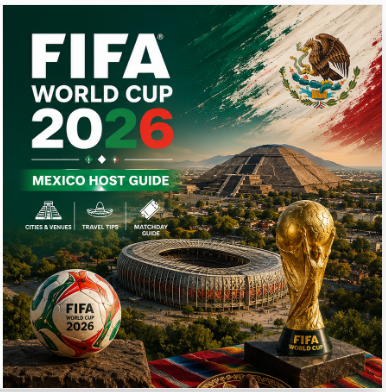


3 Iconic Cities • 3 Historic Stadiums • The Opening Match • El Tri on Home Soil
June 11 – June 26, 2026 | Group A: Mexico, South Korea, South Africa, Czech Republic
¡Bienvenidos! Mexico Makes History — Again
No nation has a more storied relationship with the FIFA World Cup than Mexico. The country hosted the tournament in 1970, when the legendary Estadio Azteca witnessed Pelé lift the Jules Rimet trophy for Brazil’s third time. It hosted again in 1986 — stepping in as an emergency replacement for Colombia — producing one of football’s most mythologised moments: Diego Maradona’s Hand of God goal and the Goal of the Century, both at the Azteca, both against England, in a quarter-final that generations of football fans have never forgotten.
Now, in 2026, Mexico becomes the first nation in history to host FIFA World Cup matches at three separate tournaments. More than that, it opens the entire tournament — the first whistle of FIFA World Cup 2026 is blown at Estadio Azteca on June 11, as Mexico faces South Africa in a match that the whole world will be watching. Three cities, three iconic stadiums, and a national team burning with the desire to match the passion of their fans on home soil finally: this is Mexico’s World Cup moment.
Mexico at World Cup 2026: At a Glance
| Host Role | Co-host — 3 cities, 3 stadiums, opening match + group stage |
| Opening Match | June 11 — Mexico vs. South Africa, Estadio Azteca, Mexico City (TOURNAMENT OPENER) |
| Mexico’s Group | Group A — Mexico, South Korea, South Africa, Czech Republic |
| All Mexico Venues | Estadio Azteca (Mexico City) | Estadio Akron (Guadalajara) | Estadio BBVA (Monterrey) |
| Head Coach | Javier Aguirre |
| Star Players | Hirving ‘Chucky’ Lozano, Santiago Giménez, Edson Álvarez |
| Mexico FIFA Rank | No. 15 (highest in Group A at draw) |
| Last Home WC | 1986 (reached Quarter-Finals, lost to Germany on penalties) |
| WC Record | 16 appearances; best result: Quarter-Finals (1970, 1986) |
| Historic Honour | First nation to host World Cup matches at THREE tournaments |
| How to Watch | Televisa / TV Azteca (Mexico) | Telemundo (USA Spanish) | FOX (USA English) |
Mexico & the World Cup: A Love Story Across the Decades
To understand what 2026 means to Mexico, you need to understand the relationship between Mexican football and the World Cup. It is not merely a national sporting interest — it is a cultural institution, a shared identity, and a source of both immense pride and heartbreak that defines each generation.
The 1970 World Cup in Mexico was the first to be televised in colour globally, and the Azteca’s 107,000-capacity crowd made it the most dramatic backdrop football had ever seen. Brazil’s team — arguably the greatest ever assembled, featuring Pelé, Jairzinho, Rivelino, and Tostao — won the tournament with such breathtaking beauty that the 1970 Mexican summer became synonymous with football at its purest. Mexico reached the quarter-finals, and an entire nation fell in love with the idea of hosting the world.
In 1986, Mexico stepped up with just ten months’ notice after Colombia withdrew. What followed was extraordinary. The tournament produced some of football’s greatest moments — none more iconic than Maradona’s solo goal against England on June 22, 1986, at the Azteca. Starting just inside his own half, he beat five English players before slipping the ball past Peter Shilton. FIFA later voted it the Goal of the Century. Mexico reached the quarter-finals, losing to West Germany on penalties in front of 114,000 people in the Azteca — still one of the largest crowds in World Cup history.
Now, forty years later, Mexico returns. The Azteca will host its third World Cup. El Tri will play in front of their own people. And a nation that has never progressed beyond the quarter-finals dreams of finally breaking the curse and going further.
| The Curse of the Fifth Game: Mexico has reached the Round of 16 (or its equivalent) at every World Cup from 1994 to 2018 — seven consecutive times — but has never advanced past it. Fans and media call it ‘El Quinto Partido’ — the fifth game. In 2026, on home soil, with the whole country behind them, El Tri finally has the best chance in a generation to break that curse. |
Mexico’s Three World Cup Venues
Mexico’s three host stadiums are among the most distinctive in world football — each representing a different face of Mexican football culture, each with its own passionate fanbase, and collectively forming the most emotionally charged group of venues in the entire 2026 tournament.
| Estadio Azteca — The Cathedral Mexico City, Distrito Federal | Capacity: 87,523 | Matches: 5 matches — Opening Match (June 11) + 4 Group Stage games. First stadium to host THREE World Cups. Mexico’s spiritual home. Where legends are born. |
Estadio Azteca: The Full Story
Estadio Azteca is not just a stadium — it is the most storied football venue on earth. Built between 1960 and 1966 at a cost of 250 million pesos, it was designed by architects Pedro Ramírez Vázquez and Rafael Mijares and opened on May 26, 1966, with a match between Mexico and Turin. With an original capacity of over 107,000 — reduced over subsequent decades to the current 87,523 following safety modifications — it has been the largest stadium in Latin America for most of its existence.
The Azteca has hosted two World Cup Finals (1970: Brazil 4-1 Italy; 1986: Argentina 3-2 West Germany) and one opening ceremony (1986). It has witnessed Pelé’s finest tournament football, Maradona’s greatest performance, and the roar of 100,000-plus Mexican fans that visiting players routinely describe as the most overwhelming sound in football. In 2026, it becomes the first stadium in history to host matches at three separate men’s World Cups — a record that, given the 60-year cycle between occasions, will never be matched.
The Azteca hosts the tournament’s opening match — Mexico vs. South Africa on June 11 — making it the venue where FIFA World Cup 2026 begins. It is also the stadium where El Tri play two of their three group-stage matches, meaning the home crowd will witness Mexico’s World Cup campaign at its most intense. Every seat in this building carries the weight of history.
| Location | Calzada de Tlalpan 3465, Santa Úrsula Coapa, Mexico City |
| Capacity | 87,523 (tournament configuration) |
| Opened | May 26, 1966 |
| Home Club | Club América (Liga MX) | Cruz Azul (Liga MX) | Mexican National Team |
| Previous WCs | 1970 (incl. Final) | 1986 (incl. Final & Hand of God match) |
| 2026 Matches | Opening match (June 11) + 4 additional group-stage fixtures |
| Getting There | Metro Line 2 — Tasqueña station; 15-min walk or connecting bus |
| Estadio Akron The Jewel of the West Guadalajara, Jalisco | Capacity: 49,850 | Matches: 4 matches — Mexico Group Stage (June 18 + June 26)Home of Chivas de Guadalajara. Mexico’s most passionate club stadium. Guadalajara: the Pearl of the West. |
Estadio Akron: Guadalajara’s Pride
Estadio Akron — officially named Estadio Akron for sponsorship reasons, but known to its supporters simply as ‘La Perla Tapatia’ or ‘The Chivas Stadium’ — is the home of Club Deportivo Guadalajara, universally known as Chivas. Built between 2007 and 2010 at a cost of approximately $180 million USD, the stadium was purpose-built as a football-only venue: no athletics track, no wasted sightlines, pure proximity to the pitch. Its design, featuring a distinctive outer shell of volcanic stone and glass, earned it a coveted FIFA five-star stadium classification.
Chivas de Guadalajara hold a unique distinction in Mexican football: they are the only top-division Mexican club with a policy of fielding only Mexican-born players. This makes their stadium one of the most patriotically charged venues in the country — a place where Mexican identity and football are inseparable. When El Tri play here, the emotional atmosphere is extraordinary.
Guadalajara itself — the second-largest city in Mexico, capital of Jalisco state, and home to tequila, mariachi music, and the charros rodeo tradition — adds cultural richness to the football experience. The city is Mexico’s heartland, and the Akron its footballing jewel.
| Location | Av. de las Rosas 3476, Zapopan, Jalisco (suburb of Guadalajara) |
| Capacity | 49,850 |
| Opened | July 30, 2010 |
| Home Club | Chivas de Guadalajara (Liga MX) — only-Mexican-players policy |
| Design | Volcanic stone facade; five-star FIFA classification; football-only |
| 2026 Matches | 4 group-stage matches including Mexico vs. Czech Republic (June 18) |
| Getting There | From Guadalajara city centre: ~25 min by taxi/Uber; limited public transit |
| Estadio BBVA — The Giant of the North Monterrey, Nuevo León | Capacity: 51,000 | Matches: 4 matches — Mexico Group Stage (June 22)Home of CF Monterrey. Stunning mountain backdrop. Mexico’s industrial capital brings industrial-strength passion. |
Estadio BBVA: Monterrey’s Mountain Fortress
Estadio BBVA in Monterrey is widely regarded as the most visually dramatic club stadium in all of Mexico — and one of the most striking in the world. Opened in 2015, the 51,000-seat venue is built into the foothills of the Sierra Madre Oriental mountain range, and its open eastern end frames a breathtaking view of the Cerro de la Silla mountain — Monterrey’s most recognisable natural landmark — as an ever-present backdrop behind the goal. No other stadium on the 2026 World Cup roster offers anything comparable.
The stadium is home to CF Monterrey, one of the Liga MX’s most successful and well-funded clubs, whose international scouting and investment give the Rayados a profile that extends well beyond Mexico’s borders. Monterrey — Mexico’s third-largest city and its industrial heartland, sitting just 150 miles south of the Texas border — brings a northern Mexican identity to the tournament that is culturally distinct from Mexico City and Guadalajara. Its proximity to the US border means significant fan crossover from Texas-based Mexican communities.
| Location | Av. Pablo Livas 2011, Guadalupe, Nuevo León (Monterrey metro area) |
| Capacity | 51,000 |
| Opened | August 2, 2015 |
| Home Club | CF Monterrey (Rayados) — Liga MX |
| Unique View | Open eastern end frames Cerro de la Silla mountain — iconic visual |
| Distance | ~150 miles / 240 km south of the US-Mexico border (Laredo, TX) |
| 2026 Matches | 4 group-stage matches including Mexico vs. South Korea (June 22) |
| Getting There | From Monterrey city centre: ~20 min by taxi/Uber; local bus services |
El Tri: Mexico’s World Cup Campaign
The Mexican national football team — El Tri, named for their tricolour strip of green, white, and red — enter the 2026 World Cup with a mission that carries the weight of forty years of quarter-final heartbreak. Under veteran coach Javier Aguirre — who previously managed Mexico at the 2002 and 2010 World Cups — the squad is a blend of experienced Liga MX stalwarts and European-based players who bring elite-level competition exposure.
Mexico is placed as the highest-ranked team in Group A and is expected to qualify for the knockout stage comfortably. Playing all three group games either at the Azteca or in front of similarly passionate Mexican crowds at the Akron and BBVA — with potentially millions of Mexicans also supporting from venues across the border in the USA — El Tri will not lack motivation. What has historically held them back is not passion but precision in high-pressure knockout moments. In 2026, Aguirre’s goal is to finally fix that.
Group A: Mexico’s Path Through the Group Stage
| Group A Teams | Mexico (FIFA #15) | South Korea (FIFA #23) | Czech Republic (FIFA #33) | South Africa (FIFA #52) |
| Match 1 | June 11 — Mexico vs. South Africa | Estadio Azteca, Mexico City (OPENING MATCH of the tournament) |
| Match 2 | June 18 — Mexico vs. Czech Republic | Estadio Akron, Guadalajara |
| Match 3 | June 22 — Mexico vs. South Korea | Estadio BBVA, Monterrey |
| Group Outlook | Mexico are strong favourites to top Group A. South Korea are the main threat for 1st place. |
| If 1st in Group | Round of 32 pathway via USA venues — venue TBC based on draw bracket |
The 26-Man El Tri Squad
| Position | Player | Club | Key Facts |
| GK | Guillermo Ochoa | Club América (MEX) | Legendary keeper; 5th World Cup; national icon |
| GK | Luis Malagon | Club América (MEX) | Young backup; strong Liga MX form |
| GK | Rodolfo Cota | León (MEX) | Veteran third choice |
| DEF | Jorge Sanchez | Ajax (NED) | Right-back; Eredivisie experience |
| DEF | Cesar Montes | Espanyol (ESP) | Centre-back; La Liga exposure |
| DEF | Johan Vasquez | Cremonese (ITA) | Serie A defender; aerial ability |
| DEF | Jesus Gallardo | Monterrey (MEX) | Experienced left-back; local hero at BBVA |
| DEF | Kevin Alvarez | LAFC (USA) | Versatile; MLS experience |
| DEF | Gilberto Sepulveda | Guadalajara (MEX) | Akron home favourite |
| DEF | Jesus Angulo | Tigres UANL (MEX) | Physical right-back option |
| MID | Edson Alvarez | West Ham United (ENG) | Premier League engine; defensive anchor |
| MID | Andres Guardado | Club América (MEX) | Captain; legendary 5th World Cup veteran |
| MID | Carlos Rodriguez | Cruz Azul (MEX) | Box-to-box; Liga MX consistency |
| MID | Orbelín Pineda | AEK Athens (GRC) | Technical creator; set-piece specialist |
| MID | Fernando Beltran | Guadalajara (MEX) | Box-to-box; Akron home idol |
| MID | Luis Romo | Cruz Azul (MEX) | Experienced Liga MX midfielder |
| MID | Erik Lira | Cruz Azul (MEX) | Defensive cover; disciplined |
| FWD | Hirving ‘Chucky’ Lozano | PSV Eindhoven (NED) | Star winger; 100+ caps; match-winner |
| FWD | Santiago Gimenez | AC Milan (ITA) | Leading striker; Serie A goals |
| FWD | Henry Martin | Club América (MEX) | Proven Liga MX goalscorer |
| FWD | Alexis Vega | Tigres UANL (MEX) | Pace and trickery on the flank |
| FWD | Roberto Alvarado | Guadalajara (MEX) | Creative forward; local Akron hero |
| FWD | Julian Quinones | Club América (MEX) | Physical centre-forward option |
| FWD | Uriel Antuna | Cruz Azul (MEX) | Wide forward; speed off the bench |
| FWD | Gibran Lajud | Tijuana (MEX) | Young striker; Liga MX breakthrough |
| FWD | Fidel Ambriz | Pumas UNAM (MEX) | Versatile attacker; pace in transition |
Key Players to Watch
Hirving ‘Chucky’ Lozano — The Heartbeat
Hirving Lozano is the face of Mexican football for his generation. The PSV Eindhoven winger — who scored the goal that knocked Germany out of the 2018 World Cup group stage in one of the tournament’s most iconic moments — carries the hopes of a nation on his shoulders. Now 30, Chucky enters this World Cup at the twilight of his international peak but with the kind of big-game experience that makes him more dangerous than ever. His pace, directness, and ability to create something from nothing make him El Tri’s most feared attacking weapon.
Santiago Giménez — The Striker in Form
Santiago Giménez has developed into one of the most prolific strikers in European football over the past two seasons, first at Feyenoord (where he scored 23 league goals in a single campaign) and now at AC Milan in Serie A. At 23 years old, he enters the 2026 World Cup as arguably the most complete Mexican striker since Hugo Sanchez — clinical in front of goal, intelligent in his movement, and capable of performing on the biggest stage. El Tri have not had a striker of this quality in decades.
Edson Álvarez — The Anchor
West Ham United’s Edson Alvarez is the engine that makes Mexico work. The defensive midfielder — strong in the tackle, composed in possession, and a leader by nature — provides the platform from which Lozano, Gimenez, and Mexico’s attack can flourish. His form in the Premier League has been consistently high, and his ability to win the ball and recycle possession quickly under pressure makes him arguably Mexico’s most important player in 2026.
Guillermo Ochoa — The Ageless Idol
Guillermo Ochoa, now 39 years old, makes history by becoming only the third goalkeeper in World Cup history to appear at five tournaments. The Club America keeper is a cultural institution in Mexico — famous not just for his saves but for his personality, his longevity, and his seemingly superhuman ability to produce world-class performances in high-stakes moments. Against Brazil in 2014, against Argentina in 2018, against Poland in 2022: Ochoa delivers when his country needs him most. Whether 2026 is his farewell or his greatest chapter remains to be written.
Road Trips: Connect Mexico’s Three Host Cities
One of the unique joys of the 2026 World Cup is the opportunity to travel between host cities by road — experiencing Mexico’s extraordinary landscapes, culture, and food along the way. Mexico’s three host cities are all connected by well-maintained federal highways, and the drives between them are genuine experiences in their own right. Here are the three road trips every football fan should consider:
| Mexico City → GuadalajaraDistance: ~565 km (351 miles)Drive time: ~5.5 hours (Hwy 15D / Hwy 90D — toll road) | The classic transversal drive across the Mexican highlands. Pass through the Valle de Atemajac, stop in Zamora or Irapuato for carnitas, and arrive in Guadalajara — Mexico’s second city — with time to explore Tlaquepaque’s artisan markets and taste the region’s famous birria before match day at the Akron. |
| Mexico City → MonterreyDistance: ~940 km (584 miles)Drive time: ~8.5–9 hours (Hwy 57D / Hwy 40D — toll road) | A long but rewarding drive north through the high desert and Sierra Madre foothills. Break the journey in San Luis Potosí (4 hrs from CDMX) — a stunning colonial city — and continue through Saltillo before descending into Monterrey’s industrial sprawl with the mountains as your arrival backdrop. Alternatively, a 90-min domestic flight connects the two cities for those short on time. |
| Guadalajara → MonterreyDistance: ~670 km (416 miles)Drive time: ~6.5 hours (Hwy 80D / Hwy 40D via Zacatecas — toll road) | The spectacular northern route through Zacatecas — a UNESCO World Heritage colonial silver-mining city worth a stopover — then on through Saltillo’s high-altitude cool and into Monterrey. This drive delivers some of Mexico’s most dramatic high-desert landscape and the chance to see colonial-era Mexico at its most spectacular between two great football cities. |
| Road Trip EssentialsAll three drives use primarily ‘cuotas’ (toll roads) — safer, faster, and better maintained than free highways. Expect to pay MXN 400-900 in tolls per journey. Fill the tank at PEMEX stations in major towns (not remote stretches). GPS or downloaded offline Google Maps are essential. If driving from the USA into Mexico, ensure your car insurance covers Mexican territory — US policies typically do not. |
Cross-Border Road Trips: USA to Mexico Venues
For fans attending matches in both the US and Mexico, several road trip options bridge the border:
| Houston (NRG) → Monterrey (BBVA)Distance: ~390 km (242 miles) via LaredoDrive time: ~4.5 hours | Cross at Laredo/Nuevo Laredo (one of the busiest land border crossings in the world), then south on Hwy 85 to Monterrey. Ensure you have the FMM tourist permit, Mexican auto insurance, and US entry documentation. The crossing itself typically takes 30-90 minutes depending on queue length. Perfect for fans attending Houston and Monterrey group-stage matches back-to-back. |
| San Antonio → Monterrey (BBVA)Distance: ~480 km (298 miles) via LaredoDrive time: ~5 hours | San Antonio — with its enormous Mexican-American population — is the natural staging post for cross-border World Cup fans. Drive south on I-35 to Laredo, cross into Nuevo Laredo, and continue south to Monterrey. San Antonio’s River Walk provides a perfect World Cup fan hub for matches at both the Texas venues and the BBVA across the border. |
| Dallas (AT&T) → Monterrey (BBVA)Distance: ~1,100 km (684 miles) via LaredoDrive time: ~10–11 hours (or fly: 1.5 hrs) | A long but doable overnight road trip for the dedicated fan. Alternatively, direct flights from Dallas/Fort Worth to Monterrey’s Gen. Mariano Escobedo airport run multiple times daily and take just 90 minutes. For those with the Semi-Final at AT&T Stadium and a group game at BBVA, this corridor will see enormous fan traffic in both directions. |
Fan Travel Guide: Visiting Mexico for the World Cup
Getting to Mexico: International Flights
Mexico’s three host cities are all well-connected internationally. Key international airports:
- Mexico City — Aeropuerto Internacional Felipe Ángeles (NLU) [new] and Aeropuerto Internacional Benito Juárez (MEX) [existing]: direct flights from most of Latin America, USA, Europe, and Asia
- Guadalajara — Aeropuerto Internacional Miguel Hid algo y Costilla (GDL): direct flights from USA (LAX, ORD, DFW, JFK) and connecting through CDMX
- Monterrey — Aeropuerto Internacional General Mariano Escobedo (MTY): strong US connections (Houston, Dallas, Miami, Chicago, New York)
Visa & Entry Requirements
Mexico operates one of the more straightforward entry systems for international visitors. Citizens of most countries — including all of North America, the European Union, the United Kingdom, Japan, South Korea, Australia, and New Zealand — do not require a visa to enter Mexico as tourists. Upon arrival, you will be issued an FMM (Forma Migratoria Múltiple) tourist permit, allowing stays of up to 180 days.
Citizens of some countries — primarily parts of South Asia, parts of Africa, and certain Asian nations — may require a Mexican visa. These should be applied for at a Mexican consulate well in advance of travel. The FIFA World Cup does not waive Mexico’s standard entry requirements, so all fans should verify requirements for their specific nationality before travelling.
| Important: Car Insurance at the BorderIf driving into Mexico from the USA, your US auto insurance policy almost certainly does NOT cover you in Mexico. Mexican law requires a separate Mexican auto insurance policy for all vehicles crossing the border. Several insurers (Baja Bound, MexiPak, Sanborn’s) offer day or weekly policies online. Driving without it is a criminal offence in Mexico and can result in vehicle impoundment. |
Getting Between Mexico’s Host Cities
| Route | Best Option |
| Mexico City ↔ Guadalajara | Domestic flight (~1 hr; Volaris, Aeroméxico, VivaAerobus from ~$30 USD) or road (5.5 hrs via Hwy 15D) |
| Mexico City ↔ Monterrey | Domestic flight (~1.5 hrs; multiple daily departures) or road (8.5 hrs — long but scenic) |
| Guadalajara ↔ Monterrey | Domestic flight (~1.5 hrs) or road (6.5 hrs via Zacatecas — spectacular route) |
| Within Mexico City | Metro (12-line network; peso fares; Azteca: Line 2 Tasqueña), Uber, METROBUS |
| Within Guadalajara | Mi Tren light rail; Uber widely available; taxis from designated ranks |
| Within Monterrey | Metro system (3 lines); Uber; taxis from authorised stands |
Money, Safety & Practical Tips
- Currency: Mexican Peso (MXN). USD is widely accepted near tourist areas and border regions but at unfavourable exchange rates. ATMs (cajeros automáticos) are the best source of pesos; Banamex, Santander, and HSBC ATMs tend to have the best rates. Avoid airport exchange desks.
- Safety: The three host cities — Mexico City, Guadalajara, and Monterrey — all have well-established tourist areas that are busy, well-policed, and safe for visitors. During the World Cup, security presence will be significantly heightened in and around all venue areas. Exercise the same common-sense awareness you would in any major city: keep phones out of sight in unfamiliar areas, use Uber rather than street taxis, and stay in well-lit tourist areas at night.
- Language: Spanish is the official language. English is spoken at hotels, major restaurants, and tourist areas in all three host cities, but some basic Spanish — hello (hola), thank you (gracias), where is (dónde está) — goes a long way and is warmly appreciated.
- Connectivity: Mobile coverage is excellent across all three cities. Purchase a local SIM card from Telcel or AT&T Mexico on arrival (available at airports for around $10-15 USD with data included) for the best rates. Most hotels, restaurants, and FIFA Fan Festival areas offer free WiFi.
- Altitude: Mexico City sits at 2,240 metres (7,350 feet) above sea level. Visitors from sea-level climates can experience mild altitude sickness (headaches, breathlessness) for the first 24-48 hours. Stay hydrated, avoid alcohol on arrival day, and take it easy. Guadalajara (1,566m) and Monterrey (540m) present no significant altitude concerns.
Where to Stay in Each Host City
| City | Recommended Neighbourhoods |
| Mexico City (Azteca) | Polanco (luxury), Roma Norte (trendy), Condesa (tree-lined, vibrant), Centro Histórico (sightseeing). Azteca is in southern CDMX — stay south or use Metro Line 2. |
| Guadalajara (Akron) | Chapultepec corridor, Tlaquepaque (artisan village atmosphere), Providencia district. Stadium is in Zapopan suburb — 25 mins from centre by Uber. |
| Monterrey (BBVA) | San Pedro Garza García (upscale), Barrio Antiguo (historic, lively), Valle district (modern, restaurant-heavy). BBVA is in Guadalupe, ~20 mins from centre. |
Mexican Food & Culture: The Fan’s Essential Guide
No country on earth offers a richer food culture than Mexico. UNESCO recognised Mexican cuisine as an Intangible Cultural Heritage of Humanity in 2010 — a designation that tells you everything about how seriously Mexicans take their food and how genuinely special it is. Every host city has its own culinary personality:
| City | Must-Eat Dishes | Must-Drink | Cultural Highlight |
| Mexico City | Tacos de canasta, tlayudas, chilaquiles, tamales, cochinita pibil, chiles en nogada (seasonal) | Mezcal, michelada, horchata, tepache | Teotihuacán Pyramids, Frida Kahlo Museum, Zocalo, UNAM campus, Chapultepec Park |
| Guadalajara | Birria (the original, with consommé), tortas ahogadas, pozole rojo, tejuino | Tequila (Jalisco is the birthplace), agua de jamaica, ponche | Tlaquepaque artisan village, Hospicio Cabañas (UNESCO), Tequila town day trip (2 hrs) |
| Monterrey | Cabrito al pastor (roast kid goat — the city’s signature dish), machaca, carne asada, pan de semita | Carta Blanca beer (born in Monterrey), sotol, aguas frescas | Cerro de la Silla hike, Barrio Antiguo, MARCO contemporary art museum, Macroplaza |
| Street Food is KingMexico’s finest food is often found not in restaurants but at taco stands, market stalls, and street carts. The Mercado de San Juan in Mexico City, Mercado San Juan de Dios in Guadalajara, and Mercado Juárez in Monterrey are essential eating destinations. A full meal of tacos, agua fresca, and dessert will rarely cost more than MXN 100-150 (approximately $5-8 USD) and will be among the best food you eat during the entire World Cup. |
Mexico at the World Cup: All-Time Record
| Year / Location | Mexico’s Result |
| 1930 — Uruguay | Group Stage |
| 1950 — Brazil | Group Stage |
| 1954 — Switzerland | Group Stage |
| 1958 — Sweden | Group Stage |
| 1962 — Chile | Group Stage |
| 1966 — England | Group Stage |
| 1970 — Mexico (HOST) | Quarter-Finals (lost to Italy 4-1) |
| 1978 — Argentina | Group Stage |
| 1982 — Spain | Group Stage |
| 1986 — Mexico (HOST) | Quarter-Finals (lost to West Germany on penalties) |
| 1990 — Italy | BANNED (FIFA ineligibility — youth team age fraud) |
| 1994 — USA | Round of 16 (lost to Bulgaria on penalties) |
| 1998 — France | Round of 16 (lost to Germany 2-1) |
| 2002 — South Korea/Japan | Round of 16 (lost to USA 2-0) |
| 2006 — Germany | Round of 16 (lost to Argentina 2-1 AET) |
| 2010 — South Africa | Round of 16 (lost to Argentina 3-1) |
| 2014 — Brazil | Round of 16 (lost to Argentina 1-0 AET) |
| 2018 — Russia | Round of 16 (lost to Brazil 2-0) |
| 2022 — Qatar | Group Stage (eliminated; failed to qualify for knockouts) |
| 2026 — USA/CAN/MEX | ? — On home soil. El Quinto Partido awaits. |
Mexico’s record is one of remarkable consistency — and maddening proximity to greatness. Fifteen consecutive World Cup appearances from 1950 to 2018 (minus the 1990 ban). Seven consecutive Round of 16 exits from 1994 to 2018. A fanbase that sings louder than almost any other. A football culture that lives and breathes the beautiful game. And a team that keeps coming agonisingly close to the quarter-finals without breaking through. In 2026, with home advantage, a talented squad, and the entire nation behind them, Mexico has its best chance in four decades.