

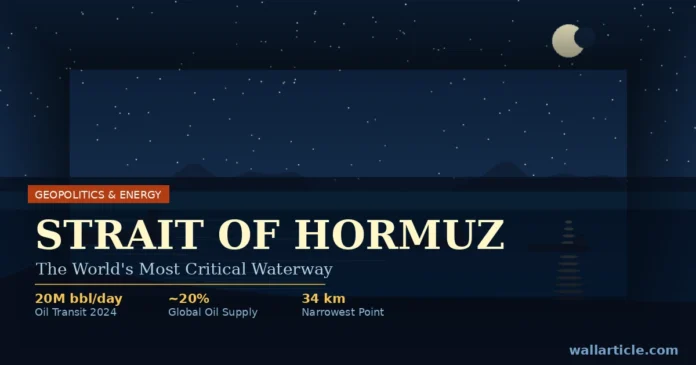


Few stretches of water in human history have carried as much weight as the Strait of Hormuz. Connecting the oil-rich Persian Gulf to the wider world, this relatively modest waterway — no wider than a mid-sized city at its narrowest point — underpins the energy security of dozens of nations and the daily lives of billions of people. To understand global oil and gas markets, you must first understand this strait.
What Is the Strait of Hormuz?
The Strait of Hormuz is a narrow channel of water that serves as the only maritime connection between the Persian Gulf and the Gulf of Oman, which leads to the Arabian Sea and the wider Indian Ocean. It is classified as a choke point — a term used in geopolitics and energy security to describe a narrow, strategically vital passage along a major global sea route.
Choke points are critical to global energy security because the inability of oil to transit one, even temporarily, can cause substantial supply delays, sharply raise shipping costs, and send energy prices soaring worldwide. The Strait of Hormuz stands above all others in this regard: it is widely recognized as the world’s single most important oil transit choke point. According to the U.S. Energy Information Administration (EIA), large volumes of oil flow through the strait and very few alternative options exist to move oil out of the region if it were ever closed.
Location and Geography
The strait lies between the southern coast of Iran to the north and the Musandam Peninsula of Oman — along with a small stretch of the UAE — to the south. It connects the Persian Gulf on the west with the Gulf of Oman and the Arabian Sea on the east, placing it squarely in the Middle East at the mouth of the Persian Gulf.
Key geographical facts:
Length: Approximately 167 km (104 miles / 90 nautical miles)
Width: Ranges from about 97 km (60 miles) at its widest to just 34 km (21 miles) at its narrowest point
Depth: 60 to 100 metres (200–330 feet) throughout most of its width — deep enough to handle the world’s largest supertankers
Shipping lanes: Two unidirectional lanes, each 3.2 km (2 miles) wide, separated by a buffer zone, governed by international maritime law (UNCLOS)
Islands: Contains 8 major islands, 7 of which are controlled by Iran; Abu Musa, Greater Tunb, and Lesser Tunb are disputed between Iran and the UAE
Climate: Dry and hot year-round; dust, morning fog, and haze can reduce visibility, especially during the dry summer months
The shipping lanes run primarily through Omani territorial waters near the Musandam Peninsula. The depth near the peninsula exceeds 200 metres in places — sufficient for supertankers whose hulls extend 20–25 metres below the waterline. Iran controls the northern coastline and maintains military bases at Bandar Abbas, Bushehr, and Chabahar, giving it a commanding position over the waterway.
The countries that border or are directly served by the strait include Iran, Oman, the United Arab Emirates, Saudi Arabia, Qatar, Kuwait, Iraq, and Bahrain.
Why Is It So Important? Oil and Energy
The Strait of Hormuz is the only sea passage linking the Persian Gulf to the open ocean. For the major Gulf oil producers — Saudi Arabia, the UAE, Kuwait, Qatar, Iraq, and Bahrain — it is the sole maritime export route for their energy output.
In 2024, oil flow through the strait averaged 20 million barrels per day (b/d), equivalent to roughly 20% of total global petroleum liquids consumption, according to the EIA. In 2025, the International Energy Agency (IEA) reported that nearly 15 million b/d of crude oil — representing approximately 34% of global crude oil trade — passed through the strait.
Beyond crude oil, the strait carries a massive volume of liquefied natural gas (LNG). Qatar, one of the world’s largest LNG exporters, ships virtually all of its gas through Hormuz. Around 20% of the world’s entire LNG trade transits this single waterway annually.
Where does the oil go?
Asia is by far the dominant consumer. In 2024, an estimated 84% of crude oil and condensate shipments through the strait were destined for Asian markets. China, India, Japan, and South Korea together accounted for approximately 69% of all Hormuz crude oil flows. For Japan, the dependence is particularly acute — about 70% of its Middle Eastern oil arrives through Hormuz, and its refiners source roughly 95% of their crude from Gulf states.
For LNG specifically, the IEA reported that Bangladesh, India, and Pakistan imported nearly two-thirds of their total LNG supplies via the strait in 2025, tying their electricity generation and industrial output directly to the security of this narrow passage.
Are There Alternative Routes?
Very few practical alternatives exist. The most significant pipeline bypasses are:
- Saudi Arabia – East-West Pipeline (Petroline)
Operated by Saudi Aramco, with a capacity of up to 7 million b/d. It carries crude oil from the Eastern Province across the Arabian Peninsula to Red Sea export terminals, fully bypassing the strait. - UAE – Abu Dhabi Crude Oil Pipeline
Links onshore UAE oil fields to the Fujairah export terminal on the Gulf of Oman, bypassing the strait with a capacity of 1.5 million b/d. - Iran – Goreh-Jask Pipeline
A nascent pipeline designed for 0.3 million b/d that connects to Iran’s Jask terminal on the Gulf of Oman. A test cargo was exported in late 2024, but the terminal has not been used regularly.
The EIA estimates around 3.5 million b/d of effective unused pipeline capacity could bypass the strait in an emergency — a fraction of the 20 million b/d that regularly flows through it. Crucially, no comparable bypass exists for LNG, making Qatar entirely dependent on the strait for its gas exports.
Strategic and Geopolitical Significance
The Strait of Hormuz sits at the intersection of competing national interests. Iran, which controls the northern coastline and several key islands, possesses both the physical proximity and military capability to threaten traffic through the waterway during periods of heightened tension.
The shipping lanes fall under Omani territorial waters near the Musandam Peninsula and are governed by UNCLOS, which guarantees the right of “transit passage” to all vessels — a principle most international maritime lawyers agree cannot be legally suspended even during political crises.- Notable historical events:
1980s – The Tanker War: During the Iran-Iraq War, both nations attacked oil tankers in the Persian Gulf. The U.S. and European navies intervened to protect commercial shipping under Operation Earnest Will (1987–88), escorting tankers under military protection.
2011–2012: Iran repeatedly threatened to close the strait in response to Western sanctions over its nuclear programme. General Martin Dempsey, Chairman of the U.S. Joint Chiefs of Staff, acknowledged in 2012 that Iran had “invested in capabilities that could, for a period of time, block the Strait of Hormuz.”
January 2021: Iran seized a South Korean-flagged oil tanker, the Hankuk Chemi, carrying roughly 7,000 tonnes of ethanol, citing alleged pollution violations.
April 2024: Iran’s navy seized the MSC Aries, a Portuguese-flagged container ship with 25 crew on board in the Gulf of Oman, steering it through the strait and claiming maritime law violations.
Daily traffic through the strait is immense. According to Britannica, it typically ranges from more than 80 to over 130 ships per day, totalling more than 30,000 tankers per year. Most are large cargo vessels, with oil tankers typically carrying more than one million barrels of crude oil each. - Economic Impact of Any Disruption
The consequences of a prolonged closure would be severe. The IEA has stated that a significant spike in oil prices would be inevitable and physical shortages would quickly develop if the strait were disrupted for an extended period.
The impact would extend far beyond direct importers of Gulf energy. Because the vast majority of the world’s spare crude oil production capacity is held by Saudi Arabia and other Gulf states — all of whom depend on the strait — a closure would simultaneously eliminate the global buffer against supply shocks. Analysts from Barclays and Goldman Sachs have highlighted the risk of sustained high oil prices and potential economic downturns in oil-importing nations if the strait were restricted over a longer period.
For LNG specifically, the IEA noted that a disruption would cause global LNG supply to drop by over 300 million cubic metres per day — roughly double the average daily flow that once passed through the Nord Stream pipeline. Given that LNG liquefaction plants elsewhere are already running close to capacity, replacing these volumes at short notice would be practically impossible.
Quick Facts at a Glance
Located between Iran (north) and Oman / UAE (south)
The only sea route out of the Persian Gulf — the sole maritime exit for UAE, Qatar, Bahrain, Kuwait, and Iraq
20 million barrels/day of oil transited in 2024 — about 20% of global consumption
~20% of global LNG trade passes through annually
84% of Hormuz crude oil is destined for Asian markets
Narrowest point: just 34 km (21 miles) wide
Water depth: 60–100 metres — sufficient for the world’s largest supertankers
Daily traffic: 80–130+ ships, over 30,000 tankers per year
Governed by UNCLOS international maritime law
Only ~3.5 million b/d of pipeline bypass capacity exists — a fraction of normal flows - Conclusion
The Strait of Hormuz is far more than a geographical feature — it is the jugular vein of the global energy system. No other single waterway carries as much economic consequence. For the Gulf states, it is the gateway to the world economy. For importing nations across Asia and Europe, it is a lifeline that powers factories, heats homes, and fuels transport. For geopolitical strategists, it remains the most watched piece of water on the planet.
Its importance will endure for as long as fossil fuels remain central to global energy, and its vulnerability to disruption means that events in this narrow stretch of water between Iran and Oman will continue to shape oil prices, diplomatic relationships, and military calculations around the world.